
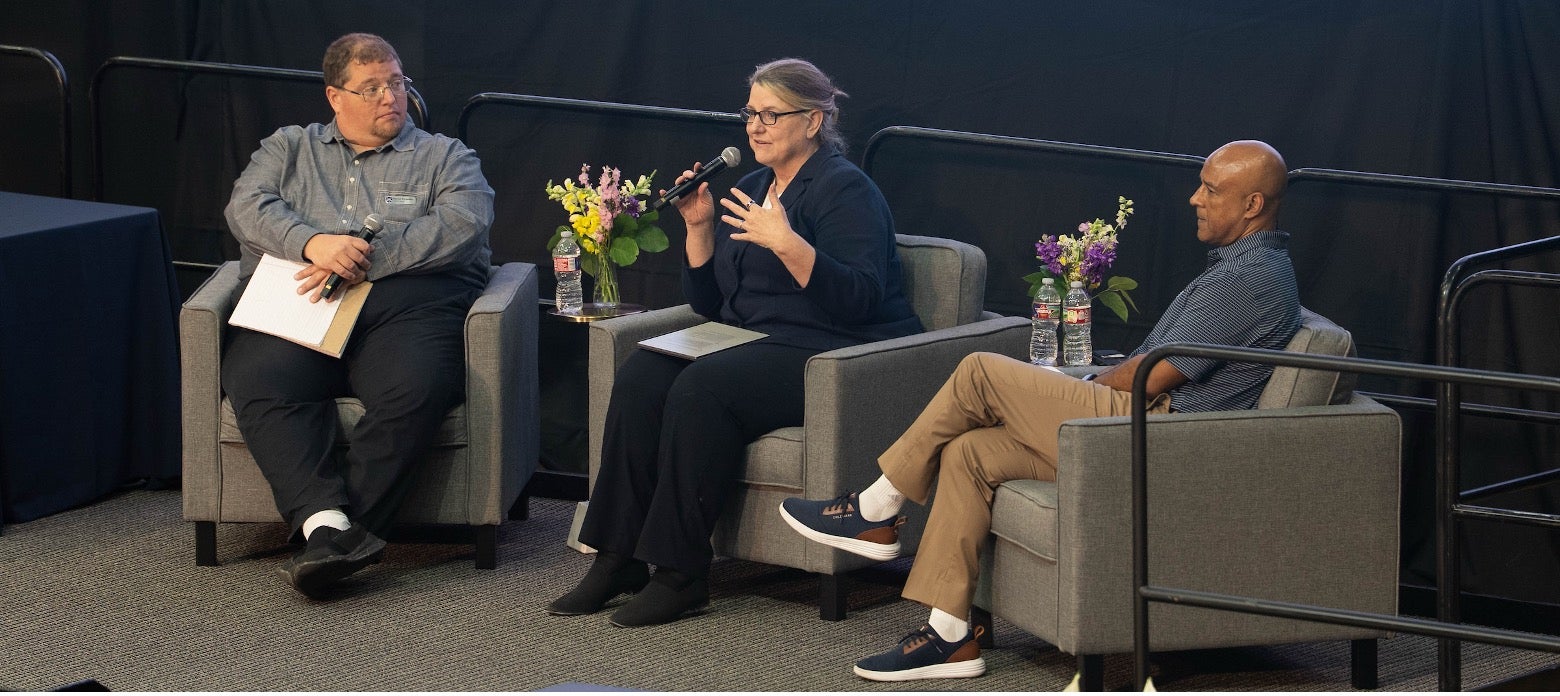
At Rice University’s Staff Appreciation event held on April 23, 2026, Staff Counsel Advocacy Subcommittee Chair Daniel Kirienko led a discussion between President Reginal DesRoches and Kelly Fox, executive vice president for operations, finance and support.
This interview has been transcribed and lightly edited for clarity. To watch the interview, click here (begins at 22:26).
Kirienko (host): Thank you all for being here today. And thank you to the executive administration for hosting this event. The first question I wanted to ask today is: How much did VSIP save Rice, and how are we using those savings to invest in our future?
Fox: Well, I’ll start, and just say, first, the VSIP program was an opportunity for us to invest in our long-serving employees. We were fortunate to be in the environment where we could offer an investment as people were planning the next stage of their careers and lives. Their departure has allowed us to think about the strategic plan and the positions we need to achieve those goals, but it's not just the positions we'll be investing in. It'll also be some technology, some training, and we're continuing to support the effort around total rewards.
I think it was about $15 million that we realized as savings from the program. That, though, is being directly reinvested. So, in all of those areas that I just mentioned, it's everything from training to people to increased compensation and benefits.
DesRoches: Let me first thank Kelly and her team for rolling out the VSIP—the amount of work that went into it and the thoughtfulness that went into it. I know there was a lot of angst around campus around VSIP. This is the first time Rice has done anything like this, and I know it created a lot of nervousness. In conversations with many of you afterward, particularly those that took it, I know there were a number of people that were appreciative, that were thinking about retirement, and really the VSIP provided them an opportunity to do it in a way that provided them with a set of resources. So again, I want to thank HR and their team for all the work that went into it. And the celebrations that took place by all the units were a great opportunity for us to acknowledge people who had served Rice for many, many decades.
Kirienko: As teams are being reorganized and reimagined around Rice, how will staff continue to be supported and compensated as they take on new and additional responsibilities?
Fox: Yeah, that's great. Thank you. I sort of alluded to it in that earlier response, but there are really three ways that we're thinking about investing in our staff. First is with professional development. We've made investments in the learning development platform within iO, and we're partnering with Glasscock to offer more opportunities. We also increased to the IRS-allowed [maximum] tuition reimbursement. So, if you want to go after something like a degree, we've increased that dollar threshold to support you as you are looking to grow and learn in these new roles.
We are also committed to investing in compensation. The total rewards program has really provided the opportunity for our benefits to come very close to market. I think by FY27, we will find ourselves with a comparable benefit that you would see at other places.
We are also, within that total rewards, able to make adjustments to staff's base pay. We've been doing that for the last two years. And I'm really pleased to remind everyone that in April we announced that we were moving our minimum salary from $15 to $18. For those of you [who were] hired on in the last month, you saw that change. And for those of you [who have been] here, you will see the effects of that pay change in September. Those are some [of the] pretty substantial investments that we've been making recently.
DesRoches: Let me just add that if you look at the strategic plan, one of the foundational parts of it is an empowered campus culture. Part of that is really helping all of you to get more training to develop new skills. This is something that we've been really promoting throughout the campus and will continue to promote moving forward. That's going to be key for us unlocking a number of things that we want to do at the university.
Kirienko: Well, regarding raises, the merit pool for fiscal year 2027 is 2%. Can you explain to us what that means and what we can expect in terms of salary increases?
Fox: Sure. Thank you. I'm sure that's on everybody's mind this time of year, having just gone through performance evaluations and all. I want to just step back for a moment and think about where Rice is in regard to the larger community in terms of things like merit pools.
We are in a very fortunate place. We have many peer institutions and other institutions of higher ed across the country that saw last year they were unable to have a pay increase, and many are continuing that again this year. So, we find ourselves feeling fortunate that we're able to provide that 2% merit pool.
When we think about what that means for your individual paycheck, several years ago, we moved to a performance merit pool process. With the new budget process we put in place, these are very local decisions. Your leadership will have access to the 2% pool and then will be looking at factors such as performance when deciding what percentage to allocate. So, you will see it being varied. I encourage you to talk to your leadership and work very closely with your team to understand how it impacts you.
DesRoches: Let me just reiterate one of the things that Kelly said. I meet with my peer presidents twice a year. Rice was really an outlier, particularly last year, when we had a merit pool when there was so much uncertainty around international students and research funding. We were one of the few universities that had a merit pool last year as well as this year, so it's something that we're proud of.
We are very healthy right now financially. There continues to be a lot of uncertainty both in the markets and in research funding, but we feel that we're in a really good position, and we're one of the few that were able to offer a merit pool the last couple of years.
Kirienko: Well, as a staff member, let me say that I really appreciate all the transparency you all have offered around this, because it does make it a lot more reassuring for staff.
Switching tacks, given that responsible AI is a foundational pillar of the Momentous plan, how do you see this coming to life for Rice? How will we take advantage of this new technology to simplify our lives?
DesRoches: I'll start with that one. Responsible AI has multiple facets that we're constantly thinking about as a university, led by various groups on campus. Obviously, there's the piece around how we educate our students in the age of AI. The provost and her team are constantly working on different ways with the deans to make sure that we're staying out front and using AI to develop critical thinking skills. We have a number of our faculty, particularly in Computer Science and Electrical Engineering, working on new AI tools in a responsible manner.
But for this audience, I think what is most on people's minds is: How are we going to think about AI in our everyday jobs? We are thinking quite a bit about that. We firmly believe that AI will be a tool to allow us to be more efficient in how we operate as a university, and I think that impacts every single one of you.
We've launched a number of different studies over the past year, in particular, to see how we can implement AI in research administration and in our development office to really allow us to do more, be more efficient, and do some things that are more mundane in an automated fashion. I think we're very early in deploying things, [but] we'll be hearing more. Maybe Kelly has more to say along those lines.
We'll be rolling some things out this summer and in the fall, particularly for staff, to help you become more fluent in AI so that you can figure out how you can best use it to be more efficient in your jobs.
Fox: I want to just build on what you were saying about all the opportunities that it presents. Sometimes, in the conversations that we're having, we talk a lot about the growth that the campus has seen. The latest information around our research awards is that we have seen like a 40% increase this year. What that means for staff is that it's a lot of work that you're absorbing as we are accomplishing the goals of the strategic plan.
We see AI as this tool that will help enable the work that you're doing and help us achieve that plan. We know that we need to give training and resources to help make sure everyone is prepared and able to utilize that fully. So, in May, you will see some information coming out about ways that you can channel your efforts around training. Whether you are in that first stage of, "Now, what is this? How could I use it?" or if you've been playing around with it and have the idea of, "This is how it might be helpful. How could I build on that skill?" It's kind of like walking you through the different levels—you know, 101, 201, 301 levels.
There will be opportunities throughout the summer, and we're continuing to build on that. Again, I would encourage you to think about the tuition remission benefit that we have. There are programs within the Jones School that are really exciting that you could also use that benefit to learn some more as well.
Kirienko: Speaking of growth, our financial situation has led to campus growth. With all this new growth and construction and this dynamism we see on campus, how do you expect the campus will look two years from now, say, five years from now?
DesRoches: Let me just step back and talk about the growth before we talk about the physical infrastructure—the growth that we're experiencing on campus in general. We've gone from a student body of around 4,000 undergraduate students a few years ago (and roughly the same at the graduate level) to this fall, where the incoming class will bring us to 5,000 undergraduate students and a little less than that at the graduate level—a milestone that Rice has never hit before.
With the growth plans we have in place, we anticipate we will be at roughly 5,400 undergraduates in 2028. That's about a 35% growth in our student body in a fairly short period of time. There is no institution in the country, public or private, that has grown that fast, and it is something we're proud of—providing more access to a Rice degree and graduating more Rice Owls.
We're coupling that, of course, with growth in faculty and staff to make sure that we have the resources and the support for our students across the various units on campus. And of course, you can't have more faculty, staff, and students without the infrastructure to support it.
You can't walk around campus and not realize there are a lot of cranes on campus right now, including a project across the street to expand the business school. We recently opened Sarofim Hall for Art. The new engineering building O’Connor was opened a few years ago. The architecture building was expanded a year ago. We have two new residential colleges that are launching this fall for the incoming class. We have the Moody Center for Student Life that's going to be finished next year.
Of course, we've talked about the Gateway Project, which includes redeveloping Rice Village, reimagining Rice Stadium, and developing the area between Rice Village and the stadium. The other aspect is the Ion District. For those who haven't been to the Ion District just a mile down the road, we view it in many ways as an extension of our campus, particularly for the opportunity to engage with industry. We have some units on campus that have moved out there already, including Development and Alumni Relations. The next building, the Arc, will be breaking ground sometime in the next year. We have commitments from faculty who are really interested in working with industry and taking some office space in the Ion District. We have space in the Helix as part of the Texas Medical Center. So really, the physical campus is expanding quite a bit as we grow our student body, faculty, and staff.
Fox: Great. I would just add to that, if you have a lot of interest and [want to see] some pretty pictures about what's happening, yesterday at the administrative forum, the team gave a bit of a deep dive on what to expect and what to see. I encourage you to go out to the website that has that information.
Before we leave this topic, I'd like to also take this moment to introduce you to our newest leader. Brian Lindorfer has joined us; he started like two weeks ago. I’m not sure if Brian is here—I was going to have him stand up if he is—but he's our new Associate Vice President for Facilities, Planning and Capital Construction, and I look forward to you getting to know him a bit better as well.
Kirienko: That's all the questions I had. I think we have some time for maybe two questions from the audience.
Staff Member: Would VSIP ever be offered again in the future?
Fox: VSIP is one of those programs that is a rare offering. I would say it's more something that's considered on 10- or 15-year time frames. So, there are no plans, but I also wouldn't say that it would never happen again. It's just something that's a more rare offering.
Kirienko: It looks like we don't have any other questions. So, I'd just like to thank the two of you for answering our questions and having this event. We really do appreciate it.